
Criminal Cases in the West Virginia Courts
West Virginia divides criminal case work among courts with distinct roles. Magistrate Courts receive criminal complaints, issue warrants or summonses, conduct initial appearances, set bond, hear misdemeanors, and hold preliminary proceedings in felony matters. Circuit Court is the general-jurisdiction trial court. It handles indictments, felony trials, sentencing, probation and revocation matters, and post-conviction filings. Municipal courts keep records for city ordinance violations and authorized traffic matters. Final criminal judgments from Circuit Court go to the Supreme Court of Appeals, not the Intermediate Court of Appeals.
The filing court creates the official case record. Circuit Clerks maintain Circuit files, while Magistrate Clerks maintain Magistrate files. The County Clerk is not the general criminal-case clerk. Statewide portals index public data, but the clerk still controls the original pleadings, orders, recordings, and certified copies. That distinction matters. A court file documents one prosecution. A West Virginia State Police rap sheet compiles fingerprint-linked arrest cycles and reported outcomes from many cases. Neither record replaces the other.
West Virginia Criminal Court Levels
Choosing the wrong court is a common reason a West Virginia court search seems empty. A misdemeanor may stay in Magistrate Court from complaint through judgment. A felony often starts there for the complaint, initial appearance, bond, and preliminary work, then moves to Circuit Court after indictment. A municipal matter may remain with a city recorder. Federal charges fall outside all three paths and use the federal docket system.
| Court | Criminal record held | Next source |
|---|---|---|
| Municipal Court | Municipal ordinances and authorized traffic cases | Municipal clerk or recorder |
| Magistrate Court | Complaints, warrants, bond, misdemeanors, and early felony events | Magistrate Clerk and MCRSearch |
| Circuit Court | Indictments, felony proceedings, judgments, and sentencing | Circuit Clerk and WVPASS |
| Supreme Court of Appeals | Appeals from Circuit criminal judgments | Appellate docket and public opinions |
Note: A city or federal case may not appear in either statewide West Virginia trial-court portal.
How to Search West Virginia Public Access Search System
The West Virginia Judiciary court-record gateway directs users to separate Circuit and Magistrate tools. The West Virginia Public Access Search System, known as WVPASS, covers public Circuit civil and criminal records in all 55 counties from 1999 forward. Registration and searching are free. Public document downloads cost $0.25 per page plus card processing, and the downloaded copy is not certified.
The official court-record gateway image shows why both portals belong in a complete West Virginia criminal court search.
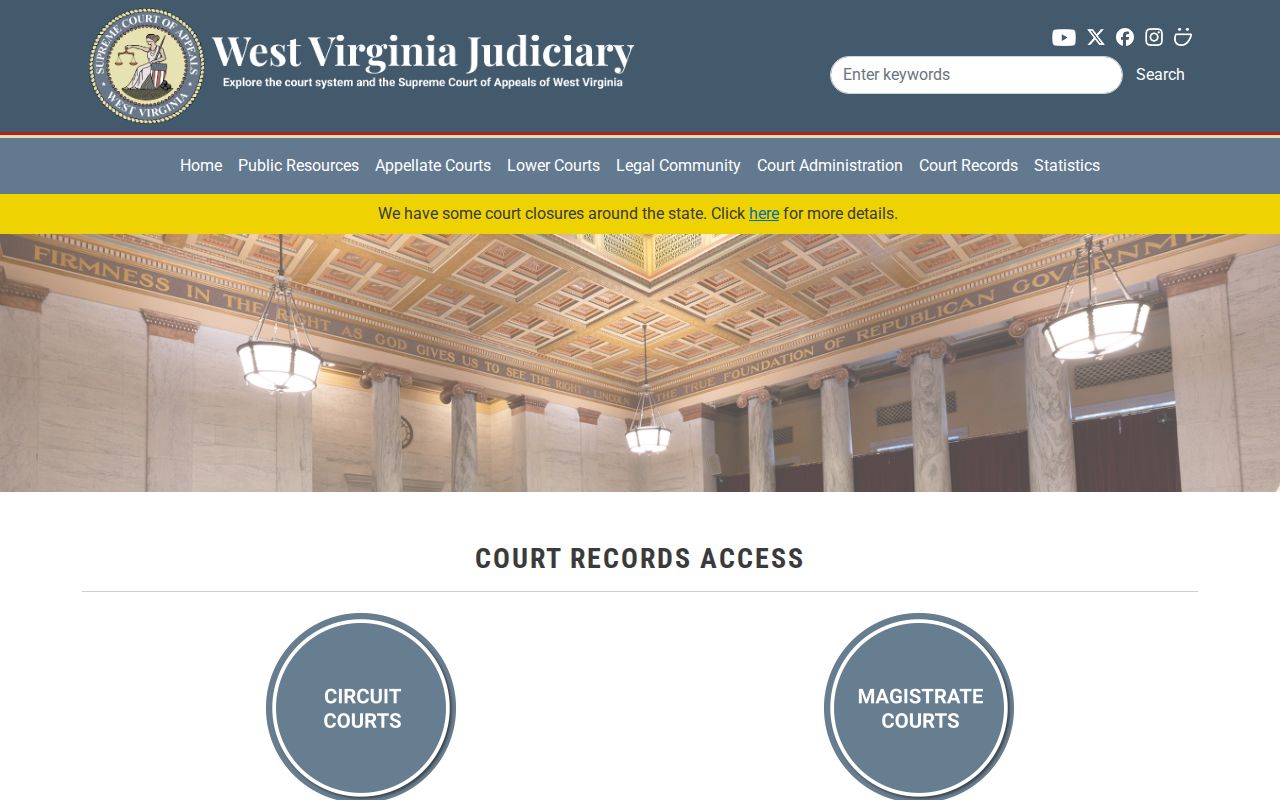
Use the Circuit route for felony dockets and the Magistrate route for misdemeanor or preliminary-felony records.
- Create a free WVPASS account and sign in.
- Search by party name or an exact case number.
- Use available filters to narrow the county and case.
- Review the docket, charges, filed documents, and judgment.
- Ask the filing Circuit Clerk for a certified or archived copy.
| Field or control | Type | Required | Use |
|---|---|---|---|
| Account email/password | Login | Yes | Free registration is required to use WVPASS |
| Party Name | Text search | One criterion | Use a full name and narrow the match |
| Case Number | Text search | One criterion | Best route when the exact number is known |
| Other filters | Filters | No | Portal supplies added filters after login |
| View / Download | Result control | No | One document at a time; no bulk download |
| Payment | Card flow | For downloads | $0.25 per page plus processing |
Two West Virginia Case Numbers
One felony can have a Magistrate case number and a later Circuit case number. That does not mean the portals contain duplicate prosecutions. Magistrate Court records the complaint, probable-cause process, initial appearance, bond, and preliminary events. If a grand jury returns an indictment, Circuit Court opens or advances the felony prosecution under its own number. The two dockets may share a person, charge theme, county, and dates while using different identifiers.
Start with MCRSearch when the arrest or complaint is the only fact known. Record the location, case ID, charge, and event dates. Then search WVPASS for the Circuit case using name variants and the known county or year. Compare the indictment and judgment instead of assuming the booking charge stayed unchanged. Copy each case number exactly. West Virginia formats vary by court and case type, so reconstructing an identifier from memory can lead to the wrong file.
What the Case File Shows
A West Virginia criminal case file is richer than a name result. MCRSearch can display basic case information, related cases, charges, events, parties, docket entries, and certain financial sections. WVPASS can make public Circuit documents available for view or download. Protected identifiers and confidential case types may be hidden. Read a judgment or order when the exact legal outcome matters.
| Case Number & Court | Identifies the filing court, location, case type, and the court-specific record key. |
|---|---|
| Charging Documents | The complaint, information, or indictment states allegations and cited statutes, not proof of guilt. |
| Docket Entries | A dated log of filings, service, bond, motions, hearings, orders, and court actions. |
| Hearing Dates | Event type, date, time, location, judicial officer, and closing reason where public. |
| Disposition | The outcome for each charge, such as conviction, dismissal, acquittal, amendment, or transfer. |
| Sentence & Judgment | The signed result may state confinement, probation, fines, restitution, costs, and conditions. |
Read West Virginia Court Dispositions
Disposition is a broad word for a charge outcome. It is not a synonym for dismissal. A dismissal ends a charge, but the order must be read to learn its terms and whether refiling is possible. An acquittal is a not-guilty decision after trial. Nolle prosequi means the prosecutor formally chose not to continue the charge at that time. A plea is the accused person's formal response; it is not the final judgment until accepted and entered.
- CDR
- Court Disposition Reporting activity sent toward the repository; it is not always a standalone public judgment.
- Indictment
- A grand jury's formal felony accusation. It remains an allegation.
- Bond
- Release conditions or security while a case is pending. Release does not dismiss the case.
- Capias
- Court process directing custody after a failure to appear or comply.
- Expungement
- A court process that removes or limits access to qualifying records after an order is granted and processed.
Note: Always match a disposition to its specific charge because one West Virginia case can contain several different outcomes.
Stages of a West Virginia Criminal Case
The agency record begins with investigation, arrest, or citation. Magistrate Court then receives a complaint, warrant, summons, or warrantless probable-cause filing. Initial appearance addresses rights, counsel, and release. A misdemeanor may proceed there to plea or trial. A felony may move from preliminary work to a grand jury and Circuit Court indictment. Circuit proceedings can include arraignment, discovery, motions, plea talks, trial, judgment, and sentence.
Case flow: Charges Filed › Arraignment › Pretrial › Plea or Trial › Disposition › Sentencing
West Virginia rules require an arrested person to appear without unnecessary delay. A felony preliminary examination ordinarily occurs within 10 days after initial appearance for a person held in custody or 20 days for a person not held, unless indictment or a lawful Circuit information intervenes. Appeals and post-conviction filings create added records. Later expungement changes public access, but it is a separate court process.
West Virginia Court Search Limits
MCRSearch covers all 55 Magistrate Courts, is free, and works on a computer or mobile device. It returns no more than 30 matching records and does not provide document images. A broad surname may therefore hide the right record. Add the first name, case ID, citation number, date range, case type, or court location. The live form also offers name-sounds-like and partial-name routes, but those choices are mutually exclusive in some searches.
The official Magistrate Case Record Search begins with terms and a CAPTCHA gate.
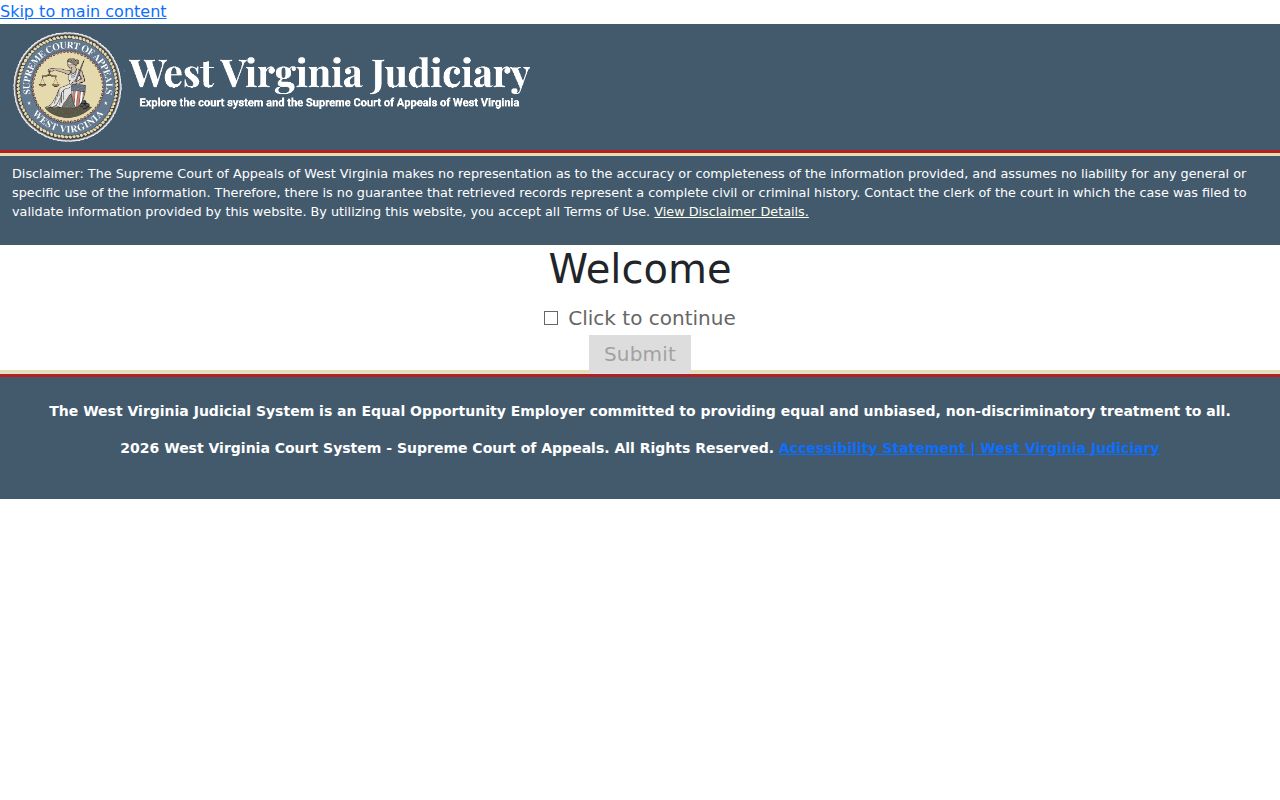
The interface warns that results are not a complete criminal history and must be checked with the filing court.
WVPASS has different gaps. Its public Circuit coverage begins in 1999, so an older case may still exist only in the clerk's archive. Sealed filings and juvenile cases are excluded. The portal offers no bulk download or update alerts. Municipal cases must be checked with the city court, while federal criminal cases use PACER. A missing online result is not proof that no record exists.
West Virginia Court Copies and Access
West Virginia law starts with public inspection but preserves limits. W. Va. Code §51-4-2 makes clerk-held court records available for inspection and copying unless a statute, rule, sealing order, or other law restricts them. Juvenile records, sealed or expunged matters, grand-jury material, protected personal identifiers, and victim-sensitive information may stay closed or redacted. WVPASS downloads are useful reference copies, not certified records.
For a document absent online, contact the clerk that holds it. Give the exact case number, party name, date range, requested filing, desired format, and a fee ceiling. Ask that the clerk identify any legal basis for withheld material and release segregable public parts when possible. The West Virginia FOIA is useful for agency records, but it does not replace the judiciary's ordinary inspection and copy process for court files.
Finding Case Records by County
The complete West Virginia criminal case file stays in the county where it was filed. The Circuit Clerk is the authoritative source for felony pleadings, orders, judgments, certified copies, and pre-1999 archives. The Magistrate Clerk supplies complaints, misdemeanor files, preliminary-felony entries, and documents that MCRSearch does not display. Municipal clerks retain city matters. Search portals help locate the record, but they do not shift custody of the original.
Use the directory of all 55 West Virginia counties to reach the correct local criminal-record site and identify the filing clerk. For a full review, compare the county judgment with the statewide repository history. That check can reveal a missing or mismatched disposition while keeping the case file and the rap sheet in their proper roles.