
Running a Check in West Virginia
The West Virginia State Police Sex Offender Registry is the official free search for qualifying public registrations. It requires acceptance of a disclaimer, but no account or search fee. The registry draws from information gathered under the West Virginia Sex Offender Registration Act. Its public purpose is protection and informed precautions. WVSP says it does not assess a listed person’s specific chance of reoffending. A profile documents a registration record and underlying listed conviction. It does not predict conduct.
Begin with a broad name search when identity is known. Use the neighborhood tool when the question concerns a West Virginia address. Search results can change as WVSP verifies reports, processes moves, and updates status. Confirm identity through the photograph, physical details, conviction information, and current profile date. Never rely on a name alone. For registration or compliance questions, use the WVSP detachment that covers the county, then use the West Virginia county directory to find the local records layer.
West Virginia Registry List Limits
West Virginia’s public search is not the full central registry. W. Va. Code §15-12-5 requires a public list, updated at least quarterly, of people subject to lifetime registration. A person with a ten-year duty is not automatically placed on that statutory list. A county resident may ask Circuit Court for information about registrants who live at or regularly visit owned or leased habitable property in that county. The court weighs the safety need against confidentiality and may limit later disclosure.
This distinction changes how “no results” should be read. It may mean the search terms did not match, the data are still being checked, or the record is outside the public layer. It does not establish that no duty or nonpublic entry exists. WVSP says the portal is updated daily, yet its disclaimer also warns that a person can fail to report a change. Treat every result as a point-in-time lead and call the registry unit when a material detail appears stale.
The official registry gateway shows the disclaimer before search access.
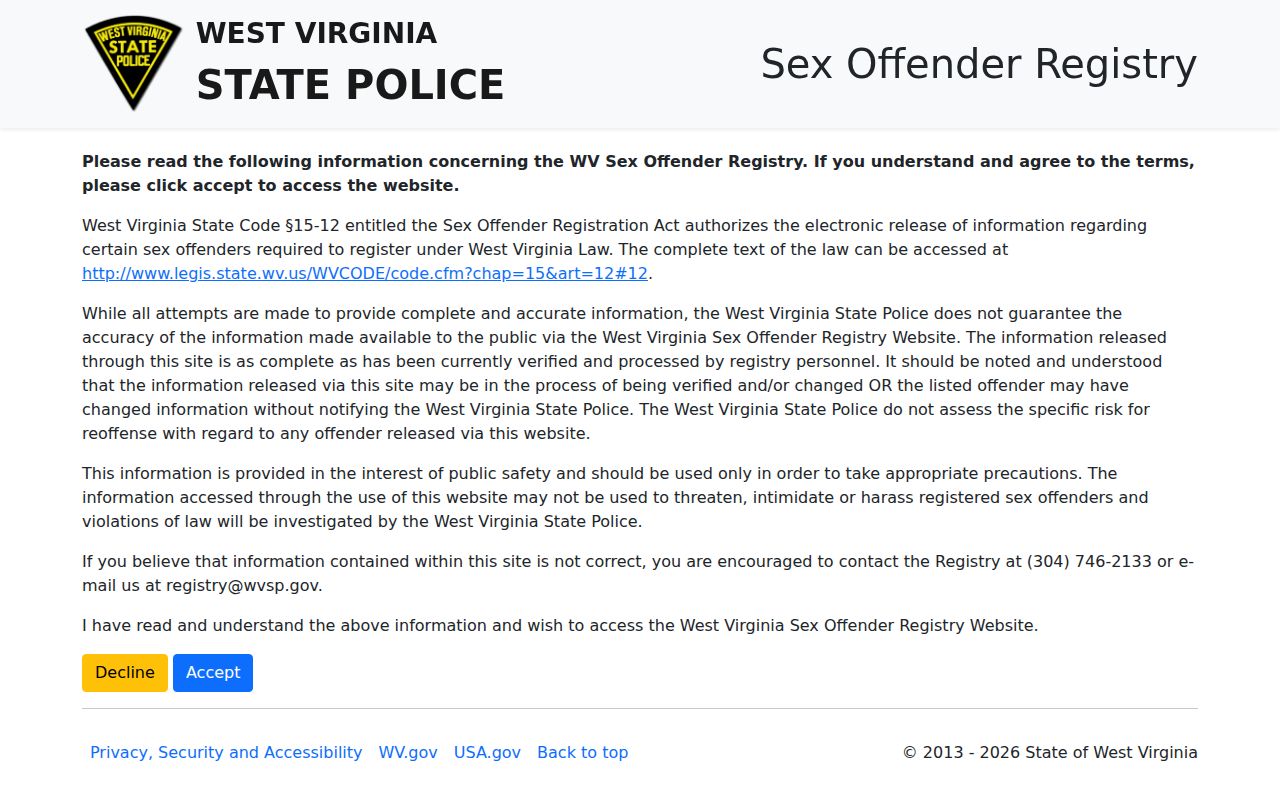
The gateway makes the limits and permitted purpose part of every West Virginia registry search.
Searching the West Virginia State Police Sex Offender Registry
The West Virginia registry has Basic, Advanced, Internet, Neighborhood, Links, and Submit a Tip tabs. Basic search can use last name, street name, city, or county. Advanced search adds filters for wanted offenders and sexually violent predators. The Internet tab searches an email address or username reported under state law. It is not an alert signup. The Neighborhood tab is the correct tool for an address-radius check inside West Virginia.
- Open the WVSP registry and read the disclaimer. Select Accept only after understanding the accuracy and lawful-use terms.
- Choose Basic or Advanced for a person or place. Use Neighborhood for an address and distance, or Internet for an email address or username.
- Review all returned cards. Open a possible match and compare the photo, age, physical description, address, and offense data.
- Check the Last Modified field and contact WVSP when identity, geography, wanted status, or another key fact remains unclear.
| Field Label | Type | Required | Notes |
|---|---|---|---|
| Search By and Search Text | Dropdown and text | Yes | Last name, street, city, or county mode; text allows up to 200 characters. |
| Advanced identity and place fields | Text and dropdown | No marker | Last name, street, city, county, wanted-only, or sexually violent predator-only. |
| Email or Username | Text | Yes | Internet-identifier search, not email notification enrollment. |
| Street, City, ZIP, County | Text and dropdown | Unspecified | Reference address for Neighborhood search. |
| Radius | Dropdown | Yes | Choose 1, 3, 5, 10, 15, or 25 miles. |
| Email Alerts | Not offered | No | No proximity-alert subscription was found in the WVSP registry. |
The search form does not require every field. A narrow filter can hide a possible match, so broaden the terms when the first search returns nothing.
Note: The Internet tab checks a reported identifier; it does not send neighborhood alerts or notify a user when a profile changes.
West Virginia Neighborhood Radius Search
The six distance choices make WVSP Neighborhood the best official tool for checking around a West Virginia address. Enter the street, city, five-digit ZIP, and an optional county, then choose a radius from one through twenty-five miles. Geography still needs review. During the August 11, 2026 inspection, different county selections unexpectedly showed the same total banner of 6,593 offenders. That number was a dated interface snapshot, not a certified county count.
Open the actual returned profiles and compare their residence fields instead of citing the banner. The federal National Sex Offender Public Website helps with cross-state name and ZIP research, but it warns that address-radius functions depend on coordinates supplied by states. West Virginia does not supply coordinates to that federal radius tool. Use WVSP for an in-state radius check and NSOPW when a search crosses state lines.
What a Profile Shows
A typical West Virginia registry result card shows a photograph, displayed name, race, gender, age, and residence address. A red Wanted badge may appear. The full profile can add date of birth, height, weight, hair, eyes, residence county and ZIP, owned or leased property, registered employer or school, and offense details. Conditional sections may state that nothing is registered. Fields vary, so the lack of one field should not be treated as proof that WVSP never collected it.
| Identity | Displayed name, full-face photograph, date of birth, age, race, and gender. |
|---|---|
| Physical Description | Height, weight, hair, and eye color when shown. |
| Residence | Street, city, county, state, ZIP, and qualifying owned or leased property sections. |
| Offense Record | Conviction date, victim relationship, protected age band and sex, plus narrative offense, sentence, and supervision text. |
| Status | Wanted badge when applicable, Last Modified date, and a Submit a Tip route. |
| Not Publicly Shown | Victim identity, Social Security number, fingerprints, phone numbers, passports, and a separate risk score. |
State law requires WVSP to collect more than the public profile publishes. Collection and internet disclosure are different legal acts. Victim identity is protected, and telephone or paging numbers may not be posted online.
Note: Profile sections are conditional, so a blank vehicle, school, work, or property field should not be read as a complete legal finding.
West Virginia Registration Uses WVSP
A common mistake is sending compliance questions to a county sheriff. Section 15-12-2 directs in-person registration to the WVSP detachment responsible for the county of residence. WVSP also sends notice to law-enforcement leaders, schools, child protective services, certain youth and care organizations, the FBI, and connected detachments. County prosecutors have a community-notification role for sexually violent predators and may have one for other lifetime registrants.
Changes to residence, work, vehicles, school, and other required information generally must be reported within ten business days. A move between West Virginia counties goes to the detachment covering the new county. An intended interstate or international move must be reported at least ten business days in advance. Nonresidents may also incur a West Virginia duty through work, school, a stay longer than fifteen continuous days, or regular visits to qualifying property.
Note: The county determines the responsible detachment and prosecutor, but WVSP maintains the combined state registry and verifies registration compliance.
Registration Requirements and Levels
West Virginia does not present a simple public Tier I, Tier II, and Tier III chart. State law instead uses ten-year registration, lifetime registration, and judicial sexually violent predator status. Duration can turn on the offense, prior qualifying history, multiple victims or violations, involvement of a minor or perceived minor, and a court’s SVP finding. A comparable duty from another state, federal court, or the military can also trigger West Virginia compliance.
| West Virginia Category | Duration | Verification Frequency |
|---|---|---|
| Qualifying ten-year registrant | Ten years from release or placement on qualifying supervision | Birth-month reporting and annual address verification |
| Lifetime registrant | Life under the conditions in §15-12-4 | Birth-month reporting and annual verification unless SVP |
| Sexually violent predator | Life | Reports in January, April, July, and October; address checked every 90 days |
| Comparable outside registrant | Depends on West Virginia law and the originating duty | Applicable West Virginia verification schedule |
Every registrant reports during the birth month even if nothing changed. Current law also sets a $125 annual payment window from January through June. The fee does not change the search cost: public registry searching remains free.
Note: West Virginia registration categories describe legal duration and verification duties; the public portal does not publish a separate risk score.
West Virginia Residency Rule Limits
West Virginia does not impose one blanket 1,000-foot rule on everyone in the public registry. WVSP says it has no broad power to choose where a registrant lives unless a court restriction applies. W. Va. Code §62-12-26 does create 1,000-foot residence, work, and loitering limits for a defined group serving specified extended supervision. Covered places include schools, child-care facilities, and the victim’s residence.
The same law limits certain people convicted of sexually violent offenses against children from living with a child under sixteen, subject to exceptions. A court may add conditions in a specific case. Read the supervision order and statute before drawing a conclusion from map distance alone. A nearby listing does not by itself prove a violation, and registry appearance does not establish that the 1,000-foot provision applies.
Correct West Virginia Registry Errors
When a West Virginia registry detail looks wrong, capture the profile’s Last Modified date and note the exact field at issue. Do not confront the listed person. Contact the WVSP registry at 304-746-2133 or registry@wvsp.gov and provide enough detail for staff to find the entry. WVSP can check whether a report is pending verification, whether an address change has been received, and whether the public profile needs an update.
The WVSP accuracy and appropriate-use notice explains those limits.
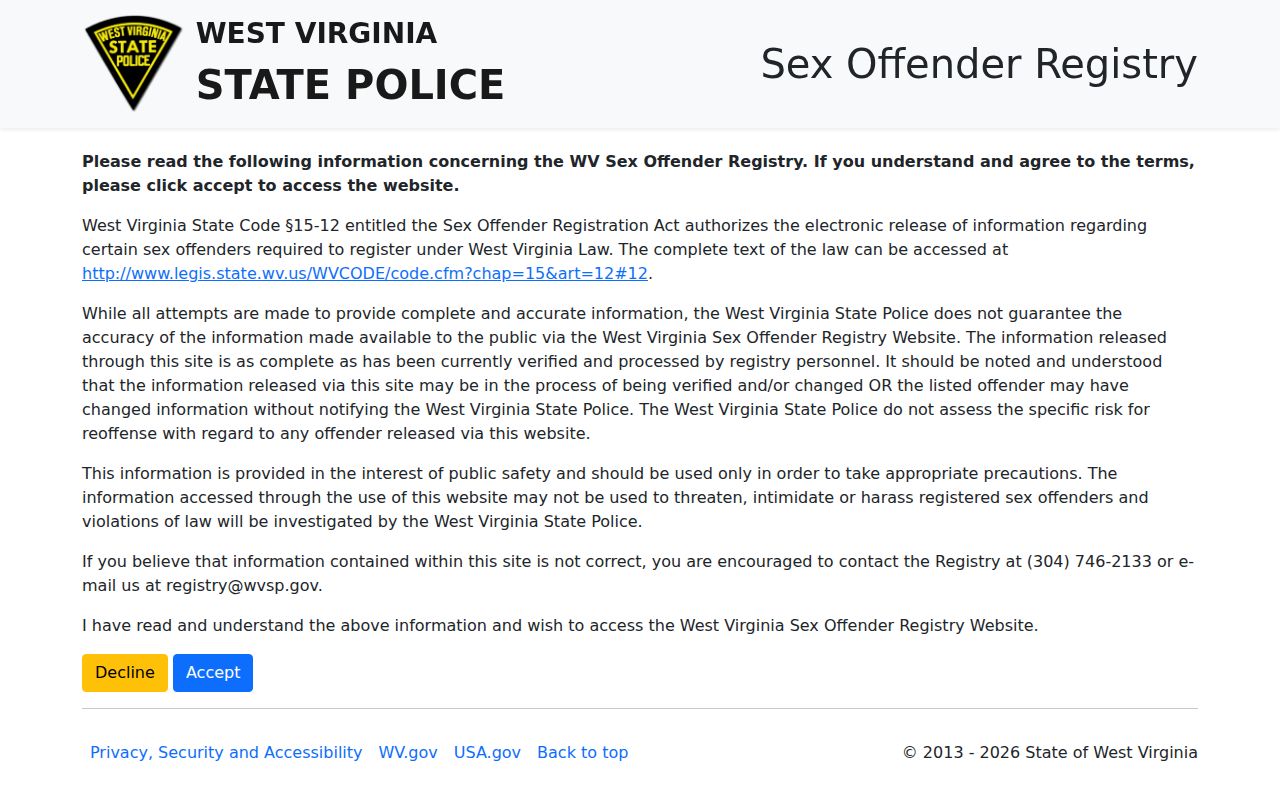
The notice is the reason a West Virginia profile should be verified before any safety decision is made.
Wanted status: A Wanted badge may concern alleged registration noncompliance. Do not approach the person. Contact law enforcement, and call 911 for an immediate threat.
West Virginia and National Searches
NSOPW gathers public registry data from participating U.S. jurisdictions. It is useful when a person may have moved across state lines or when a name search must extend beyond West Virginia. It does not replace WVSP for the meaning of a West Virginia duty, correction of a West Virginia entry, or selection of the responsible detachment. Run both searches when the facts cross a border, then compare the jurisdiction and source shown on each result.
The Department of Justice national registry interface supports that wider check.
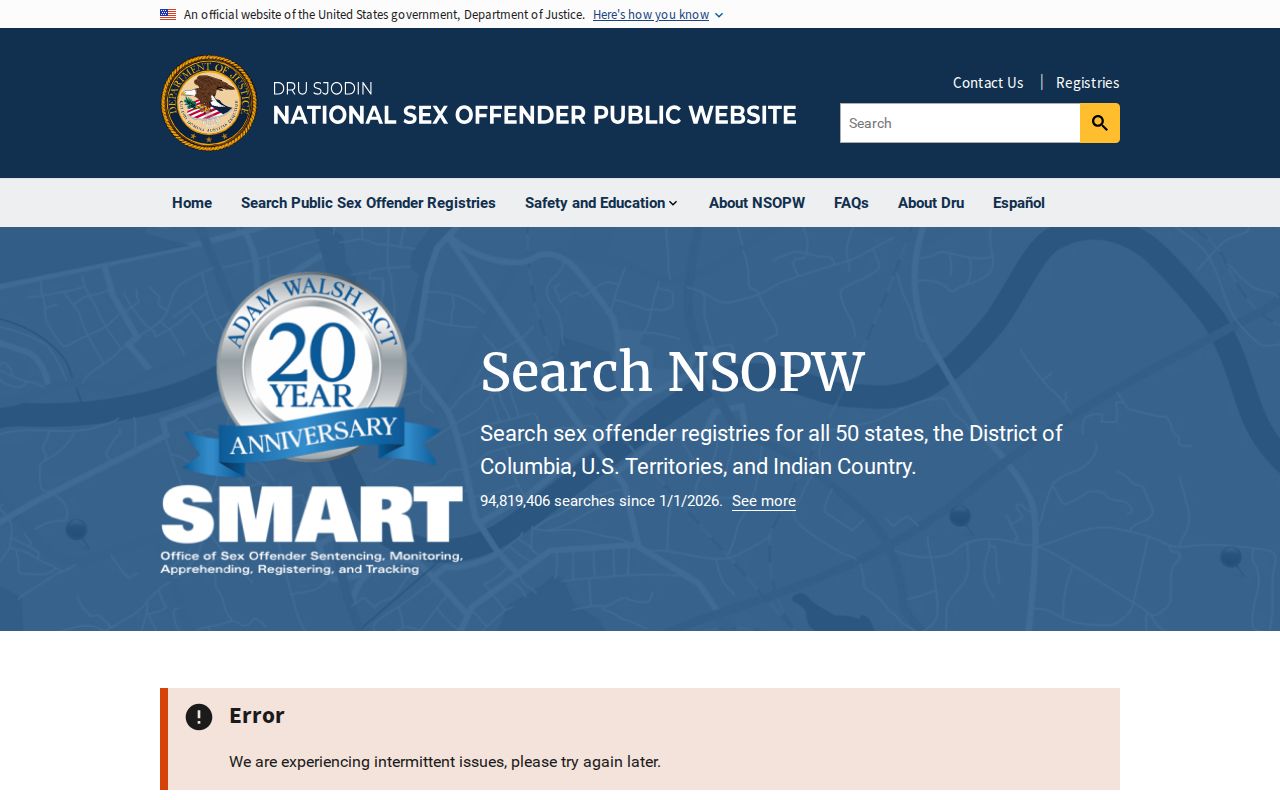
The national layer widens geographic coverage, while WVSP remains the controlling source for West Virginia registration details.
Note: A national result should be traced back to the named jurisdiction’s official profile before relying on status, address, or duty.
Lawful Use
The West Virginia Sex Offender Registration Act describes registration as regulatory public protection, not added punishment. Use registry information for awareness, family safety, and reasonable precautions. Do not use it to infer current dangerousness or conduct beyond the listed conviction. WVSP’s entry notice bars threats, intimidation, and harassment. The Submit a Tip form also warns that knowingly false information or use of registry data to commit a crime may lead to prosecution.
Article 12 does not supply a stand-alone registry-misuse penalty. Other West Virginia criminal laws still apply. For example, W. Va. Code §61-2-9a covers specified stalking and harassment. Suspected noncompliance belongs with WVSP or the responsible detachment, not with a private confrontation. The registry exists to help the public take informed precautions while police investigate and enforce the law.
Do not misuse registry data. Never threaten, intimidate, harass, or target a listed person. False tips and criminal use of registry information can lead to prosecution.