
About the West Virginia State Police
The West Virginia State Police Criminal Identification Bureau sits within the Criminal Investigation Division. Its Criminal Records Section is the public-facing contact for the statewide repository. W. Va. Code §15-2-24 authorizes the bureau to maintain fingerprints, photographs, criminal records, and investigative information. The bureau also manages biometric identification and connects qualifying West Virginia data to FBI systems.
WVSP is an aggregator and steward, not the source of each event. Arresting agencies submit fingerprint-backed arrest information. Courts and magistrates submit dispositions. The bureau then joins those facts into charge cycles in the West Virginia Computerized Criminal History system. Related CIB work includes AFIS biometrics, Court Disposition Reporting, Uniform Crime Reporting, expungement processing, the Sex Offender Registry, the Child Abuse Registry, and several law-enforcement record programs.
The official WVSP Criminal Records page identifies the authorization and fingerprint channels.
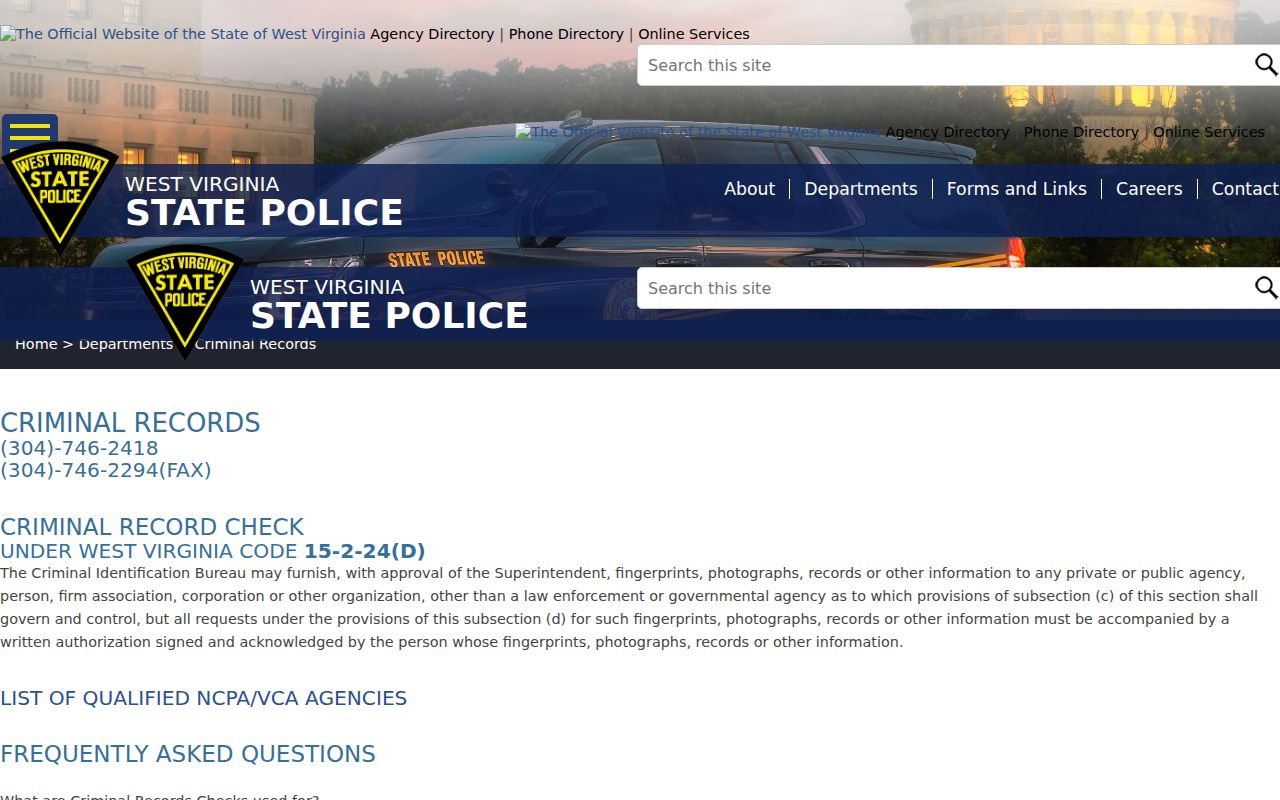
The agency page directs requesters away from headquarters walk-ins and toward the approved fingerprint process.
Why WVSP Has No Public Name Search
WVSP does not offer an unrestricted, instant name-only repository search for casual public use. Under §15-2-24(d), covered disclosure to a private person or organization requires written authorization that is signed and acknowledged by the person whose record is sought. The official system is purpose-coded and fingerprint-based. A service code determines eligibility, routing, and price.
Public court systems answer a different question. WVPASS searches public Circuit Court cases, while Magistrate Case Record Search covers public Magistrate matters. They can help a person understand a case but do not equal a WVSP criminal history. They may omit sealed data, other court levels, older records, and information outside the public docket. Conversely, a WVSP rap sheet does not contain every pleading, order, transcript, or scanned county document.
Key distinction: A court name search finds public cases. A WVSP check uses fingerprints to match the subject to the state criminal history repository.
Criminal History Checks Offered by WVSP
West Virginia State Police products differ by legal purpose. There is no single generic fee to quote. The total appears after the correct IdentoGO service code is entered because state, FBI, and vendor components vary. Personal review lets a person inspect a fingerprint-linked state record. Some lawful programs authorize a state and FBI response. Qualified organizations under the National Child Protection Act and Volunteers for Children Act use a restricted agreement and authorization process.
| Product | Who May Order | What It Returns | Cost |
|---|---|---|---|
| Authorized WV state fingerprint check | Subject or authorized requester with the correct service code | Purpose-authorized, fingerprint-matched West Virginia history | Service-code total shown by IdentoGO |
| State and FBI fingerprint check | Qualifying statutory program | West Virginia response plus authorized national result | Service-code total with applicable components |
| Personal review or self-audit | The record subject | Fingerprint-linked record for review and possible challenge | Service-code amount |
| NCPA/VCA check | Qualified entity under a restricted agreement | Program-specific West Virginia and FBI result | Billing or service-code amount |
| WVSP record challenge | The record subject | Administrative correction review, not a new public search | $20 with Form 136A |
WVSP also processes qualifying expungement orders. That process carries the $100 State Police fee set by W. Va. Code §61-11-26. It is not a background-check product, and a person begins the petition with the Circuit Clerk in the county where the arrest began.
Note: IdentoGO shows the purpose-specific total during enrollment because WVSP does not publish one universal fee for every criminal-history product.
WVSP and IdentoGO Fingerprints
The IdentoGO West Virginia location finder is the official fingerprint appointment route and shows current service and site options. Choose West Virginia, select Schedule or Manage Appointment, and enter the service code supplied for the authorized purpose. The code controls where the response goes and which charges appear. Entering the wrong code cannot simply be transferred to a different program and may require a new enrollment and payment.
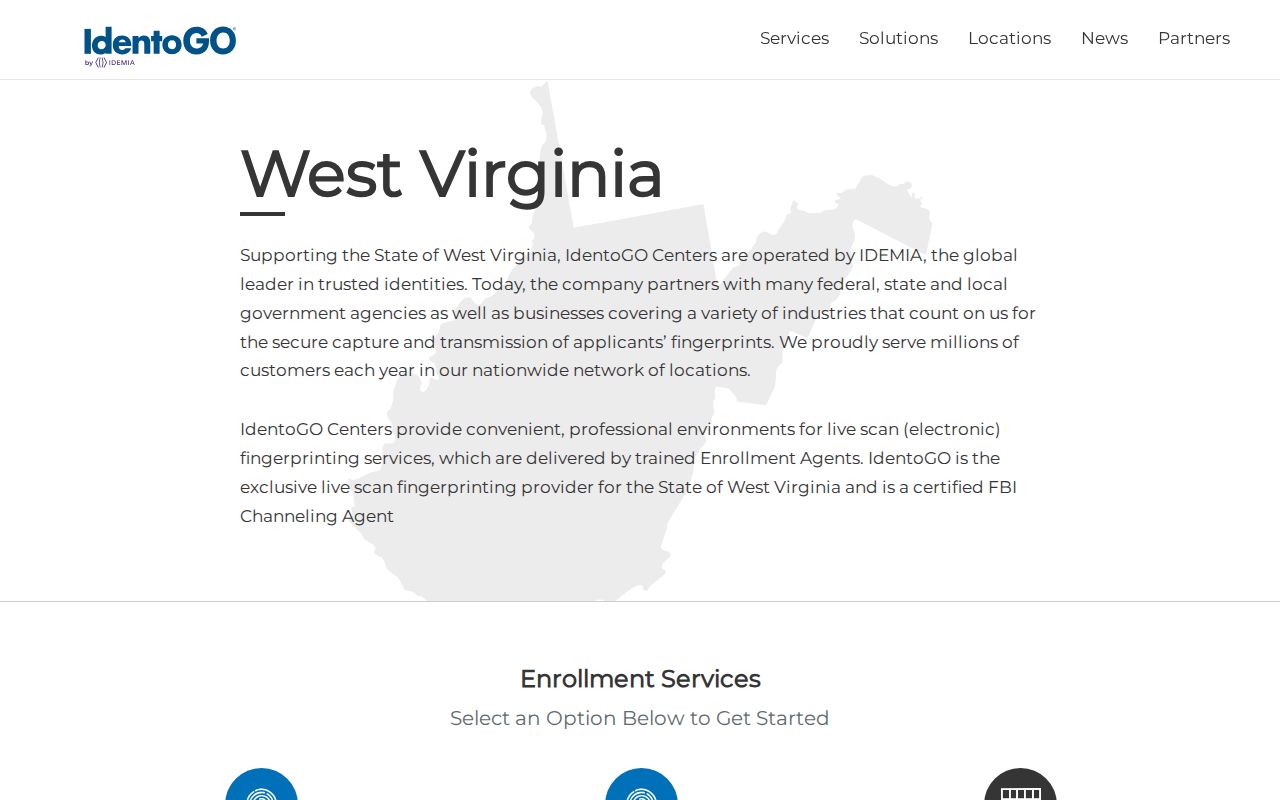
The location step routes each requester to a current enrollment center rather than an outdated fixed site.
Enrollment asks for legal name, identity details, contact information, an appointment time, approved identity documents, and payment unless the program bills separately. WVSP headquarters no longer performs walk-in checks. Ordinary fingerprinting by a local law-enforcement office is not a substitute for the designated route. Out-of-state subjects may see a prepaid fingerprint-card-by-mail option or an out-of-state IdentoGO live-scan choice with added processing costs.
Note: Call WVSP Criminal Records at 304-746-2418 before enrollment when the correct personal-review service code is unclear.
How Records Flow Into the WVSP Repository
A West Virginia criminal history starts with an arrest event, not a typed name. A sheriff’s deputy, municipal officer, State Police trooper, campus officer, or another authorized officer creates the report. Booking staff capture identity details and fingerprints. Those prints allow CIB to connect the event to the right biometric identity in AFIS and the Computerized Criminal History file.
Data flow: County Arrest › Fingerprint Submission › West Virginia State Police › Court Disposition Reporting › Rap Sheet
The court track develops separately. Magistrate Court may record the complaint, warrant or summons, initial appearance, bond, preliminary felony steps, and misdemeanor docket. A felony indictment proceeds in Circuit Court. Clerks and magistrates then furnish disposition data in the form WVSP requires. A complete repository cycle needs demographics, fingerprints, arrest data, and a disposition for every charge.
A gap can occur when a disposition has not arrived, an arrest card lacks enough identifiers, an older paper record was not digitized, an alias blocks an automatic match, or a local correction has not reached WVSP. Systems update on different schedules. The best check compares the statewide entry to the originating county record in the county directory.
Note: A missing repository outcome may reflect reporting lag, so obtain the certified court disposition before assuming the case remained unresolved.
WVSP Criminal Records by Numbers
The 2023–2024 WVSP annual report measures workload, not unique people or complete files. CIB processed 43,046 criminal arrest events and 22,273 incarceration events. It imaged about 49,122 Court Disposition Reports and 25,905 criminal cards. It also handled 72,332 applicant background investigations, 15,335 sex-offender registration transactions, and 2,938 law-enforcement backgrounds.
Those totals show the scale of the repository pipeline. They do not prove a statewide completeness percentage. No current official share of arrests with final matched dispositions was found. WVSP’s continuing verification of AFIS and CCH arrest cards shows why correction work remains important, but it cannot be converted into a missing-record rate. Treat each transaction measure as agency workload and audit an individual history against the court source.
How to Order a WVSP Check
Start with purpose, not price. A self-review, a state-only authorized check, a state-and-FBI check, and an NCPA/VCA check follow different rules. WVSP does not publish one universal total or turnaround time. The service code supplies the correct scope, price, and routing. For a personal audit, keep the enrollment receipt and any transaction or control number so a later status question can be traced.
- Open the WVSP Criminal Records page and identify the authorized product. Call the Criminal Records Section if the proper self-review code is not clear.
- Use IdentoGO to select West Virginia, enter the exact service code, and choose a current enrollment location.
- Enter identity and contact details exactly as shown on the required documents. Bring those documents to fingerprinting.
- Complete fingerprint capture and payment. Save the confirmation number, receipt, and response instructions.
- Read the result charge by charge. Obtain the county court file for the full case detail behind any entry that needs review.
A state check covers West Virginia-contributed history for its authorized purpose. It is not automatically a national self-review. The FBI provides a separate Identity History Summary route for a person seeking federally maintained multistate information.
WVSP Records From Cards to AFIS
CIB began in 1933, and a 1935 fingerprint law supplied the legislative base for fingerprint classification and the Criminal Records Section. West Virginia joined the NLETS interstate network in 1966. In 1971, CIB adopted an FBI and NCIC-compatible classification approach, and state law authorized mandatory Uniform Crime Reporting. Operational reporting followed in 1972. Court Disposition Reporting pilots ran from 1977 through 1979.
The state adopted NIBRS in 1999. At the end of 2019, an upgraded AFIS and new livescan units expanded electronic submission across detachments, jails, and correctional facilities. Court data also changed. CourtPLUS became operational in all 55 counties by July 2024. WVPASS opened public statewide Circuit Court access in March 2025, and a near-real-time lower-court statistics dashboard followed in July 2026.
The timeline explains the mixed record landscape. Modern fingerprints and electronic reports can move fast, while older paper material and delayed court matches may still need manual review. Technology improves transmission, but a system upgrade does not itself prove that every historical charge has a matched outcome.
Note: Digital access dates describe system milestones, not a guarantee that every older West Virginia record is online or fully matched.
WVSP Checks vs County Records
A WVSP rap sheet and a county court file serve different jobs. The state history compiles fingerprint-linked cycles reported from across West Virginia. It is the better starting point for reviewing whether the state repository associates an arrest with the correct identity and outcome. The county file is the original case source. It can show complaints, docket entries, motions, orders, plea papers, sentencing detail, and certified dispositions that never appear on a summary history.
| Question | WVSP Check | County Records |
|---|---|---|
| Coverage | West Virginia-contributed repository history statewide | Arrests and cases created in one county |
| Identity basis | Fingerprint-backed match | Name, case number, local identifiers, and source documents |
| Freshness | Depends on agency and court reporting | Docket changes as the case moves |
| Detail | Compiled arrest and disposition summary | Original pleadings, orders, logs, and certified copies |
| Best use | Personal state-history review | Understanding and proving the exact case outcome |
Neither source replaces the other. A recent county dismissal may not yet appear in CCH. A county name search may also miss a fingerprint-linked event elsewhere in the state. Compare both before filing a challenge.
WVSP and FBI Self-Review
The FBI Electronic Departmental Order portal begins a national Identity History Summary request for the subject, not another private person’s report. A direct request costs $18 and requires fingerprints. It may also be submitted by mail or through an approved channeler. Channelers and participating fingerprint locations may add their own fees. The FBI does not offer a name-only version, does not return the fingerprint card, and does not promise expedited service.
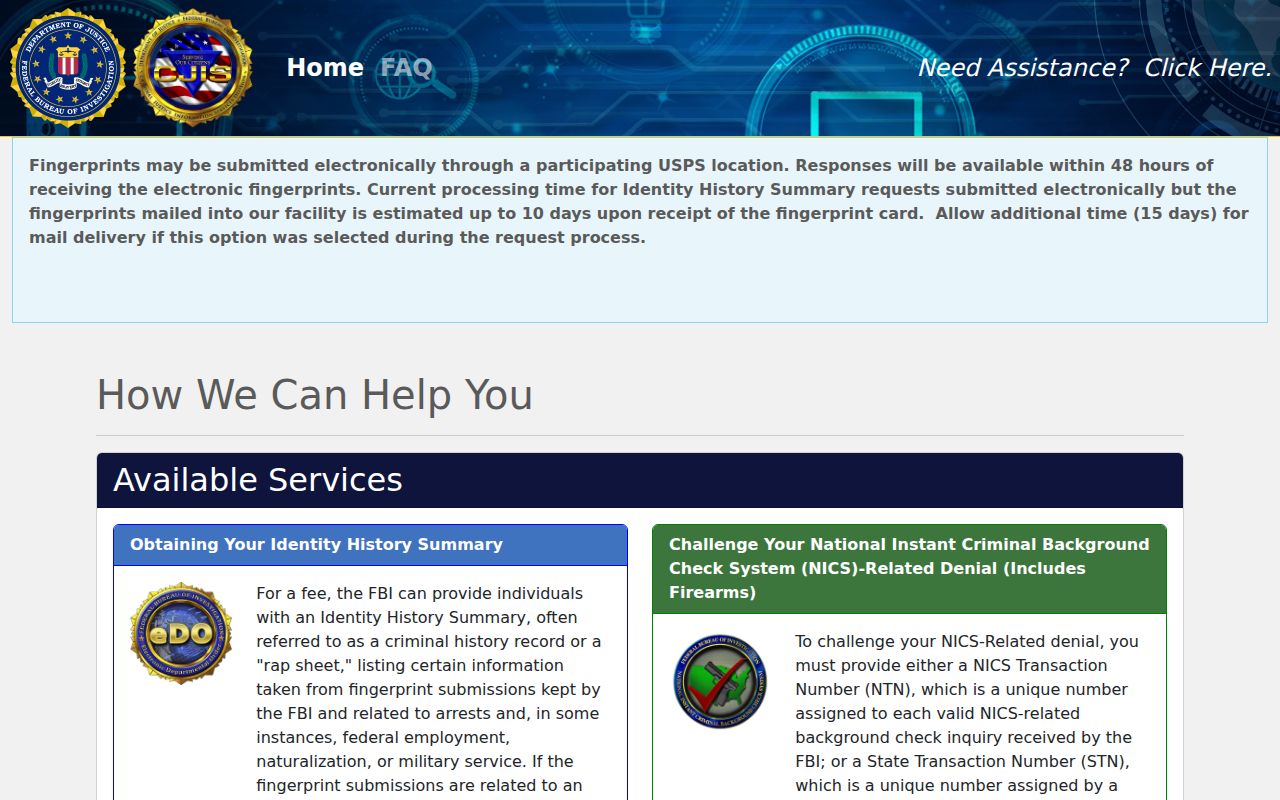
The federal order complements a WVSP review when the subject needs to inspect multistate information maintained by the FBI.
A West Virginia error can appear in both results because the state contributes data to federal systems. If the FBI entry repeats an incorrect West Virginia charge or outcome, correct the contributing state source. Certified county documents and the WVSP challenge process support that change. The FBI route is useful for the national layer, but it does not replace the county case file or decide whether WVSP’s source fact is correct.
Note: Correct a West Virginia-contributed fact through its state and county sources even when the same fact also appears in an FBI summary.
WVSP Form 136A Corrections
WVSP Form 136A is the Direction to Challenge a Criminal Record. It asks for the challenger’s name, address, Social Security number, date of birth, and the agency where the record was reviewed. The disputed section compares what the record now says with what it should say. Each side can identify the entry number or date, charge and date, and disposition and date.
The form also asks for the basis of the challenge, the number of attached signed sheets, a right index fingerprint, signature, and date. The current instruction calls for a $20 check or money order payable to the Superintendent of WVSP. Supporting material should come from the court or arresting agency that contributed the fact. Keep copies and proof of mailing.
Form 136A is not the expungement petition. For expungement, WVSP directs the person to obtain the history and contact the Circuit Clerk in the county where the arrest began. After a qualifying order, WVSP processes repository changes and sends a certified completion letter to the clerk. Status questions about the court process go to the clerk.
Correcting Errors in Your WVSP Record
First identify the source of the error. A wrong arrest detail may originate with the arresting agency. A missing disposition may belong to the Magistrate or Circuit record. A mismatched identity can involve fingerprint or demographic linking. Correcting the creator’s record, supported by a certified disposition, gives WVSP the evidence needed to update the statewide history.
- Order your fingerprint-based personal history through the correct WVSP and IdentoGO service code.
- Compare each arrest cycle with MCRSearch or WVPASS and obtain a certified county disposition when an outcome is wrong or absent.
- Ask the contributing arresting agency or court to correct its source record when appropriate, then complete Form 136A.
- Send the form, right index fingerprint, supporting records, and $20 payment as directed. Retain copies and proof of mailing.
After the correction, obtain a fresh record and compare the changed cycle. If the same state-contributed error appears in an FBI summary, use the FBI challenge route and show that West Virginia corrected the source. A careful audit follows the record from county creation to WVSP and, when relevant, into the federal system.