
How to Check Criminal History in West Virginia
Start by naming the record needed. The West Virginia State Police Criminal Identification Bureau holds the fingerprint-linked state history. WVPASS finds public Circuit Court cases from all 55 counties beginning in 1999, while Magistrate Case Record Search covers misdemeanor complaints and early felony events. The West Virginia Division of Corrections and Rehabilitation publishes separate regional-jail and prison searches. Each source answers a different question. None replaces the arresting agency's report or the county clerk's filed orders.
Gather a full legal name, known aliases, date range, county, and any case or report number. Search both court levels when a felony began before a magistrate and later moved to Circuit Court. A common-name result is only a lead. Fingerprints are the stronger identity key, and a certified disposition is the safer proof of a court outcome.
- Use WVSP and IdentoGO to review your own fingerprint-based West Virginia criminal history.
- Search WVPASS for Circuit Court records and MCRSearch for Magistrate Court activity.
- Check WVDCR for recent regional-jail custody or sentenced state-prison custody.
- Open the county records site for the clerk, arrest report, and local filing source.
- Compare identifiers and obtain a certified record when accuracy matters.
West Virginia Records Move in Stages
An arrest creates several records. The officer writes an incident or arrest report. A regional jail or other custodian records intake, received charges, fingerprints, bond references, and status. Fingerprints and arrest data then reach the WVSP Criminal Identification Bureau. Magistrate and Circuit clerks create the court dockets and send Court Disposition Reporting data after each charge is resolved.
The path is: Arrest → Booking → Fingerprint Submission → County Court Case → Disposition Report → WVSP History. Timing gaps explain why a jail entry can appear before a case, or why a rap sheet can lack a disposition already present in a county file. The 2023-2024 WVSP report records 43,046 processed criminal arrest events and 49,122 imaged court dispositions, but those are workloads, not a count of unique people or a present completeness rate.
When records disagree, start with the office that created the disputed fact. Get a certified county disposition for a court outcome, then use the WVSP challenge route if the repository entry remains wrong.
The West Virginia Criminal History Repository
The West Virginia State Police criminal history repository sits in the Criminal Identification Bureau. Under W. Va. Code §15-2-24, it maintains fingerprints, photographs, criminal history, and related identification information. Local police, sheriffs, regional jails, and courts contribute data. WVSP compiles those events, but it does not create every source fact or keep the full packet of pleadings from a county case.
West Virginia does not offer an unrestricted public name-only WVSP history portal. A personal review or other authorized official check uses fingerprints through IdentoGO by IDEMIA and a purpose-specific service code. Public name research instead begins with the court, custody, and registry tools. Covered dissemination to a private person or organization requires the record subject's signed and acknowledged authorization.
West Virginia Fingerprint Record Review
A review of your own official state history starts at the WVSP Criminal Records Section. The page directs applicants to IdentoGO's West Virginia enrollment network. Select the correct service code, schedule a current location, enter your legal identity details exactly, bring the required documents, and retain the transaction receipt. WVSP headquarters no longer handles ordinary walk-in checks, and fingerprints taken for another purpose cannot simply replace this purpose-coded channel.
No universal fee should be assumed. The service code controls eligibility, routing, scope, and the total shown during enrollment. A state-only response and an authorized state-plus-FBI response are distinct products. For a national self-review, the FBI also offers its own $18 Identity History Summary through the electronic order portal, mail, or an approved channeler.
Statewide Record Systems in West Virginia
West Virginia has no single search that merges every criminal record. The repository is fingerprint based. Circuit and Magistrate courts have separate public tools. WVDCR divides recent regional-jail custody from sentenced prison custody. The sex offender registry serves public-notice duties created by state law. Read each system within its scope, then use the county layer for the original report, complaint, order, or certified copy.
The statewide systems help locate the right event. The county file supplies the deeper local proof. A repository rap sheet may show an arrest and reported outcome without the motion, judgment, or officer narrative found in the original records.
| System | What It Holds | Run By |
|---|---|---|
| Fingerprint criminal history | Fingerprint-linked arrests and reported dispositions | WVSP Criminal Identification Bureau |
| WVPASS and MCRSearch | Public Circuit and Magistrate case data | West Virginia Judiciary |
| WVDCR offender searches | Regional-jail, prison, daily custody, and absconder data | WVDCR |
| WVSP Sex Offender Registry | Public information for qualifying registrations | West Virginia State Police |
A West Virginia arrest history search must account for the difference between an alleged event, a booking, and a court result. WVDCR can show a recent regional-jail intake or current custody, but it does not supply the officer's narrative and does not establish guilt. The arresting agency holds its report. The Magistrate or Circuit file shows what prosecutors filed and how each charge ended. WVSP may later connect the fingerprint-supported arrest with the reported disposition in the state history. Comparing those layers prevents a received booking charge from being mistaken for a conviction.
The West Virginia sex offender registry search serves a different public-safety purpose. It reports qualifying public registration information maintained by WVSP under Article 12 of Chapter 15. A registry profile is not a general rap sheet, and the public system does not assign a risk score. Searchers can use names, location tools, and other published fields, then read the complete profile and last-modified date. Registration and change reporting go through the responsible State Police detachment. County sites help route local questions, while the statewide WVSP registry remains the official public source.
West Virginia Court Data Changed
West Virginia's court access moved quickly from 2024 through 2026. CourtPLUS reached all 55 counties in July 2024. The public Magistrate search followed, and WVPASS opened statewide Circuit Court access on March 10, 2025. These tools do not merge the two court levels. They also do not turn public docket research into a fingerprint criminal history.
The Judiciary's July 2026 lower-court statistics announcement shows the newer statewide dashboard interface:
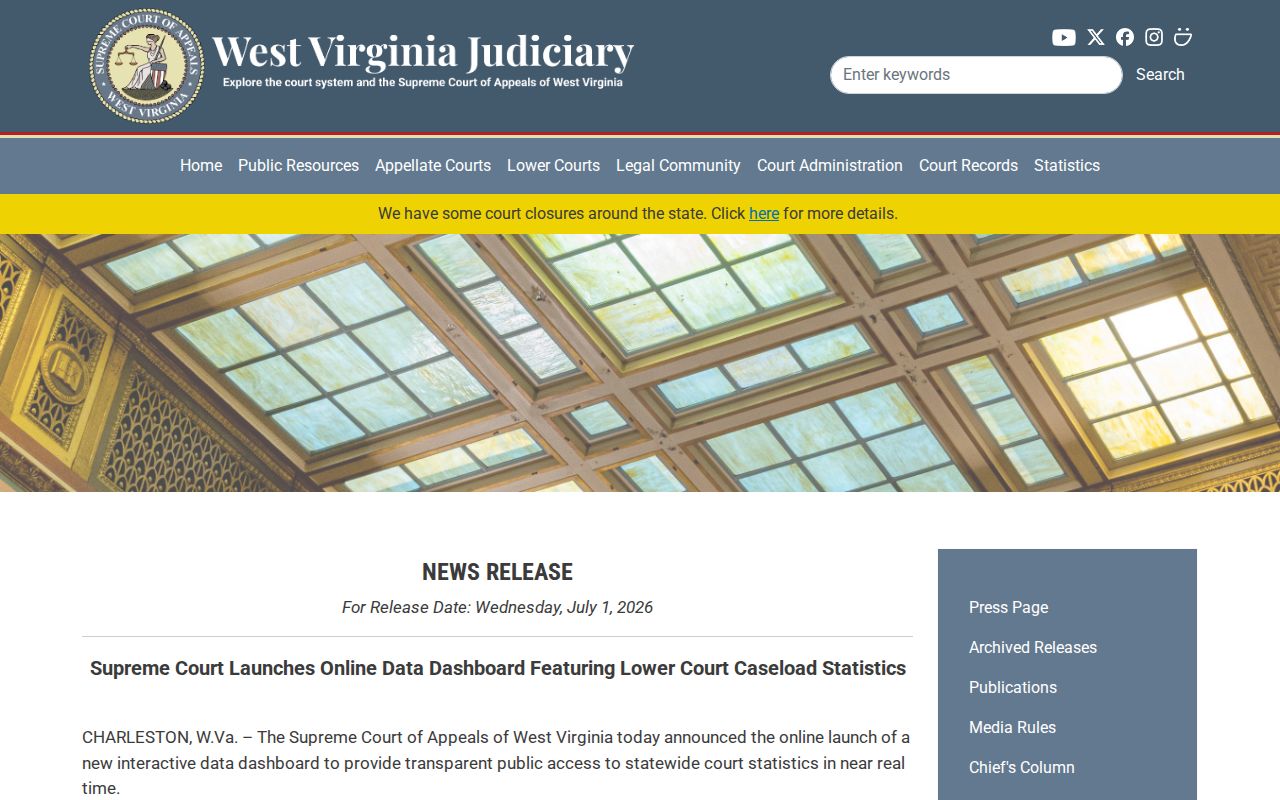
The dashboard reports court workloads and active case counts by selected filters. It is not a person-name case search. Use WVPASS or MCRSearch for an individual public case, and confirm the result with the filing clerk.
Types of Criminal Records
West Virginia criminal records are grouped by who creates them. An officer creates the incident and arrest report. WVDCR or another custodian creates a booking record. Magistrate and Circuit clerks maintain case files. WVSP compiles fingerprint-supported arrest and disposition events into a rap sheet. The Parole Board and WVDCR record parole decisions and supervision, while the Judiciary maintains probation orders and dockets.
- Arrest and booking records: allegations, intake facts, received charges, bond references, and custody status.
- Criminal court case files: complaints, indictments, hearings, pleas, orders, judgments, and costs.
- Repository rap-sheet entries: fingerprint-linked identity, arrest cycles, charges, and reported dispositions.
- Warrants: court process whose public visibility depends on status, court level, and confidentiality.
- Supervision and registry records: probation, parole, absconder, and sex offender public information within legal limits.
- Disposition
- The recorded result for one charge, such as conviction, dismissal, or acquittal.
- Rap sheet
- A chronological repository response, not a packet of court documents.
- CDR
- Court Disposition Reporting data sent to WVSP to close an arrest charge cycle.
- Capias
- Court process directing custody after a failure to appear or comply.
West Virginia Warrant Checks
No unrestricted WVSP or WVDCR public statewide active-warrant list was found. A Magistrate Court docket in MCRSearch may show a warrant issued, service, commitment, bond, or release event. A Circuit case may carry related process in WVPASS. Those entries do not guarantee that an active, sealed, municipal, juvenile, or investigative warrant will appear online.
Search both court systems when appropriate, then contact the issuing Magistrate, Circuit, or municipal clerk. Ask for the case number, issuing court, charge, date, current status, and bond information that can lawfully be released. Do not send money because of an unsolicited warrant call. Resolution belongs with the issuing court, and legal advice may be wise before appearing.
Active warrant concern: Confirm the court and case through an official clerk or law-enforcement channel before taking action.
Public Access Laws
The West Virginia Freedom of Information Act gives access to nonexempt records held by public bodies, while criminal-history dissemination and court-access rules set different limits for different files. Send a narrow request to the custodian that maintains the record. Under FOIA, the body generally has five business days, excluding weekends and legal holidays, to produce the record, set an inspection time, or deny the request in writing. Protected details can be redacted while public portions remain available.
Key Statutes:
W. Va. Code §29B-1-3 grants access to nonexempt public records and allows actual reproduction costs.
W. Va. Code §29B-1-4 protects specified law-enforcement, privacy, and security information.
W. Va. Code §15-2-24 governs the CIB repository and covered private dissemination.
W. Va. Code §51-4-2 addresses public inspection and copying of clerk-held court records.
W. Va. Code §61-11-26 sets the petition route for eligible conviction expungement.
West Virginia Jail and Prison Records
West Virginia's regional jail structure changes the usual county model. Many counties send people to WVDCR regional facilities instead of running a separate sheriff jail roster. The WVDCR search hub links a regional-jail inmate search, Daily Incarcerations, a prison offender search, and Escapees/Absconders. Regional-jail results address current or recent intake. Prison results address sentenced state custody. A transfer can change which search is useful.
A profile may display an identifier, photo, descriptors, admission date, facility, committing county or court, received charges, sentence data, and projected dates. Fields differ by tool. WVDCR warns that custody data can change and does not prove guilt. Use the court judgment for the outcome and the arresting agency for the report narrative.
The West Virginia Parole Board's public resources show the statewide parole authority:
The Board decides qualifying release matters, while WVDCR Parole Services supervises people in the community. Probation is different. It is imposed by a court and administered through the state judicial branch's circuit-based probation system.
West Virginia Criminal Record Expungement
Expungement is not automatic when a charge ends. Section 61-11-25 covers defined nonconviction routes. Section 61-11-26 permits petitions for certain misdemeanors and nonviolent felonies, subject to offense and history exclusions. The headline waits are generally one year after completion for one eligible misdemeanor, two years for multiple eligible misdemeanors, and five years for an eligible nonviolent felony. The current law and actual order control.
The official West Virginia expungement statute sets the petition contents, notice recipients, limits, and processing charge:
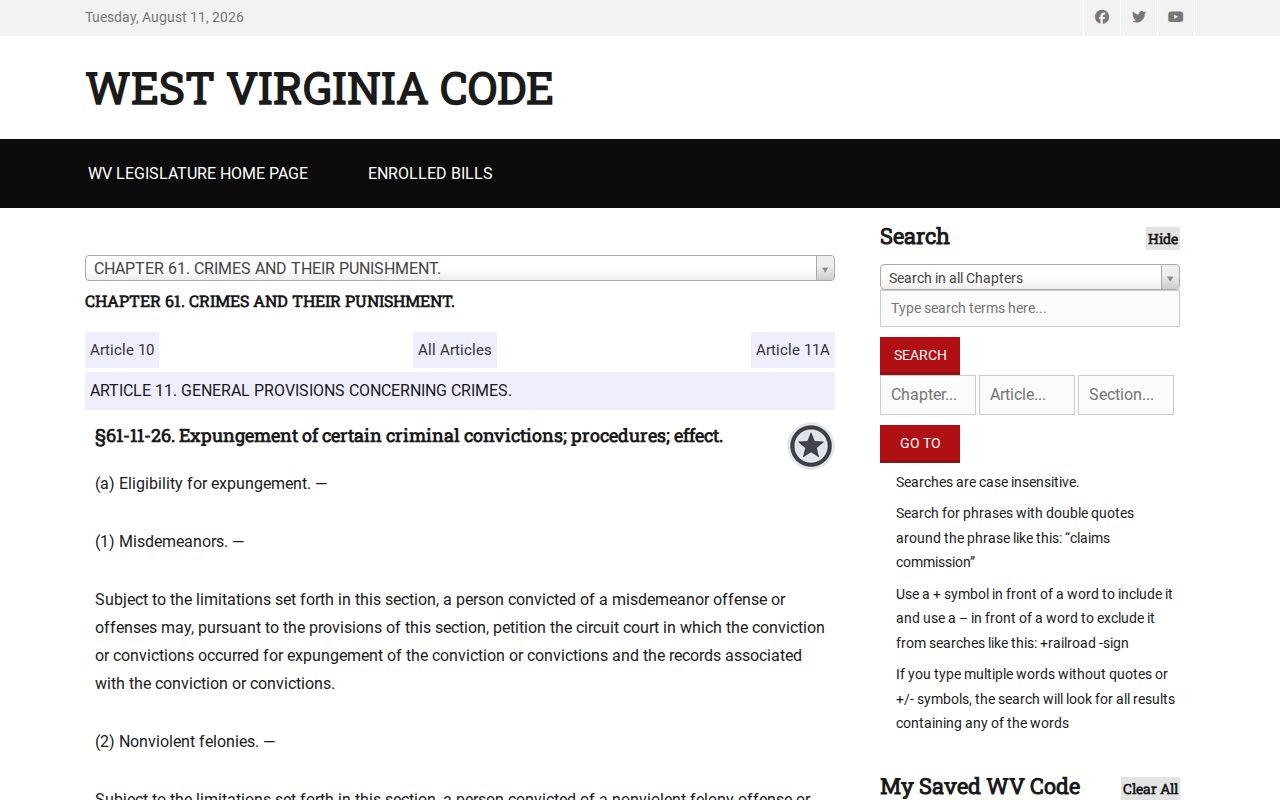
File in Circuit Court in the county required by the statute. Obtain your fingerprint history first, identify every arrest and case number, and gather certified dispositions. After an order, WVSP processes its records and returns a certified completion letter to the clerk. Recheck the official history and public court systems after processing.
West Virginia Felonies and Misdemeanors
West Virginia does not use one universal Class A, B, or C ladder for all crimes. Under W. Va. Code §61-11-1, a felony is an offense punishable by confinement in the penitentiary; other offenses are misdemeanors. The statute for the charged offense supplies its own prison or jail range and fine. A booking label can change after a prosecutor reviews the case.
Felonies proceed in Circuit Court, though a magistrate can handle the initial appearance and preliminary steps. Misdemeanors generally remain in Magistrate Court unless a specific law directs otherwise. Municipal violations stay with the city court. Copy the exact code citation from the docket, open the current statute, and read the judgment for the sentence actually imposed.
West Virginia Police Report Requests
There is no statewide pool of every local incident report. Request the report from the sheriff, municipal police department, WVSP unit, campus police, or other agency that investigated. Include the report number, date, location, record type, preferred format, and a fee-estimate ceiling. If the agency has no direct form, use the West Virginia Freedom of Information Act and ask for segregable public portions when some facts are exempt.
WVSP Form 141 is limited to records WVSP created. Its verified charges include $20 for a crime or crash report by mail, $50 for video or audio, $25 per set of up to 12 photographs, and $1 per page after page 50. These fees do not set local agency prices. The original report records the investigation, while a booking record records custody and the court file records prosecution.
Find Criminal Records by County in West Virginia
Arrest reports, Magistrate complaints, Circuit Court files, and certified copies remain tied to the county where the event occurred. The largest local record centers include Kanawha, Berkeley, Monongalia, Cabell, Wood, Raleigh, Harrison, and Jefferson counties. Every one of West Virginia's 55 county folders has a dedicated records site.
Kanawha County
Charleston · State-capital county and the state's largest local court system
Berkeley County
Martinsburg · Fast-growing Eastern Panhandle court center
Monongalia County
Morgantown · Major north-central county record center
Cabell County
Huntington · Western metro dockets with separate regional custody records
Wood County
Parkersburg · County clerk records paired with regional jail data
Raleigh County
Beckley · Southern court hub with a separate WVDCR custody channel
Browse the full directory of all 55 West Virginia counties to open the criminal records site for any county.
West Virginia Criminal Record Fees
Costs depend on the record and channel. Searching is often free, but documents, certified copies, challenges, and official fingerprint checks can cost more. Ask for the total before ordering. County clerks may add authorized copy, certification, postage, or media charges.
| Record or Service | Official Amount |
|---|---|
| WVPASS search | Free registration and search |
| WVPASS public document | $0.25 per page plus processing |
| MCRSearch | Free, with no document images |
| Circuit Clerk paper copy | $1 per page under §59-1-11 |
| Written Magistrate history search | $25 per name |
| WVSP Form 136A challenge | $20 |
| Eligible conviction expungement | $200 filing plus $100 WVSP processing |
| WVSP fingerprint check | Service-code total shown by IdentoGO |
Federal records sit outside this table. PACER covers federal court cases, and the Bureau of Prisons locator covers federal custody. An FBI Identity History Summary is a separate personal-review product, not a West Virginia county case file.